
Implantable Contact Lenses versus Lasik
ICL vs LASIK in Singapore: Which Is Right for You?
Many patients considering vision correction ask me whether LASIK or EVO Implantable Collamer® Lens (ICL) surgery is the better option.
Both procedures can reduce dependence on glasses and contact lenses, but they work in very different ways and may suit different types of eyes.
At The EyeClinic by Dr Cheryl Lee, I assess every patient personally to determine the most suitable vision correction procedure for them.
What Is LASIK?
LASIK is a laser vision correction procedure that reshapes the cornea to improve how light focuses on the retina.
It is commonly used to treat:
— myopia
— astigmatism
— hyperopia
LASIK permanently changes the shape of the cornea.
What Is EVO ICL?
EVO Implantable Collamer® Lens (ICL) surgery involves placing a small biocompatible lens inside the eye without removing corneal tissue.
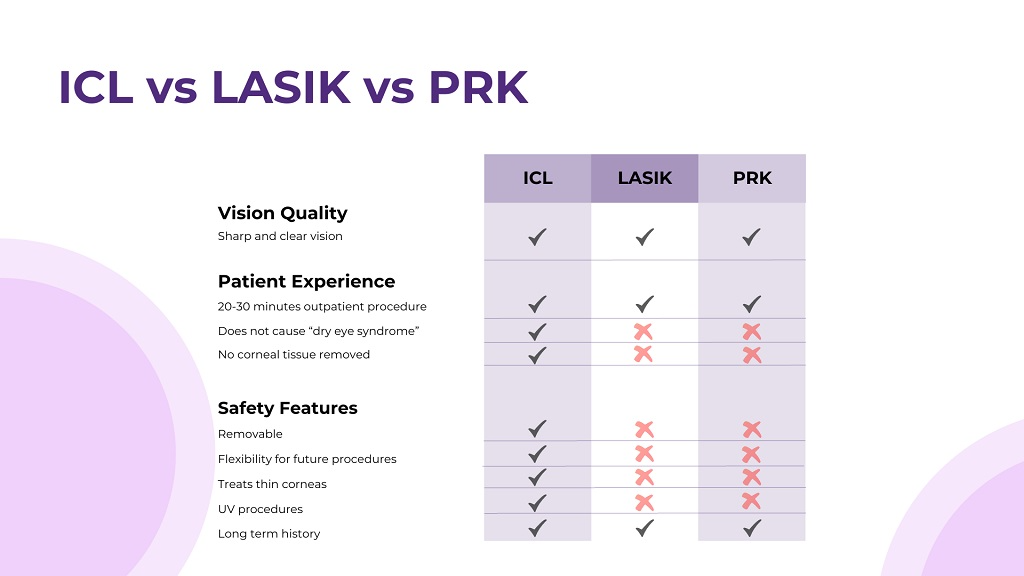
Unlike LASIK, EVO ICL preserves the natural structure of the cornea and is reversible if necessary.
Key Differences Between ICL and LASIK
LASIK
— laser reshapes the cornea
— permanent tissue removal
— suitable for many patients with moderate refractive error
EVO ICL
— lens implanted inside the eye
— cornea remains largely untouched
— reversible
— suitable for low and high degrees of myopia and astigmatism, and for thinner corneas
Who May Prefer EVO ICL?
EVO ICL is particularly suitable for patients with:
— dry eyes, or who wish to avoid developing dry eye after surgery
— active lifestyles, including sport
— concerns about permanent corneal reshaping
— corneal scars
— a wish to keep their options open for reading vision later in life
Dry Eye Considerations
Some patients experience dry eye symptoms after laser vision correction because corneal nerves are affected during the procedure.
As EVO ICL does not reshape the cornea in the same way, it may be an important option for patients concerned about dry eyes.
Reversibility and Long-Term Planning
One advantage of EVO ICL is reversibility.
Presbyopia, and later cataract, come to almost everyone. When they do, the implanted lens can be removed or exchanged.
Which Procedure Is Better?
There is no single "best" procedure for every patient.
The most suitable option depends on:
— prescription
— corneal thickness
— dry eye status
— lifestyle
— long-term visual goals
A detailed consultation and eye assessment are important before deciding on surgery.
My ICL Experience
I have extensive experience in EVO Implantable Collamer® Lens surgery and have taken part in international ICL expert meetings and surgeon education programmes.
My practice focuses on personalised refractive surgery planning, particularly for patients with high myopia, dry eyes and complex refractive profiles.
Read more about my ICL experience
FAQ
Is ICL safer than LASIK?
Both procedures are considered safe when performed on suitable patients. The best option depends on individual eye anatomy and visual needs.
I take additional steps to reduce ICL risks, such as UBM ultrasound for ICL sizing. Read about it here.
Can ICL cause dry eyes?
EVO ICL does not reshape the cornea, so it does not affect the corneal nerves in the way laser can. Dry eye can still occur for other reasons, and your dry eye status is part of the assessment.
Is ICL reversible?
Yes. One of the advantages of EVO ICL is that the lens can be removed or exchanged in the future, for example when cataract or presbyopia develops.
Implantable Contact Lens verus PRK vs Lasik
An ICL story I have never forgotten
Many years ago, I met a German lady who had received one of the earliest implantable contact lenses approximately 25 years earlier.
By the time she came to see me, her eyes — and her visual needs — had naturally changed. She had developed presbyopia and wanted to explore a different solution for her vision.
This meant removing the ICL that had been sitting quietly inside her eye for around a quarter of a century.
I remember the moment very clearly.
The lens slipped out smoothly.
After approximately 25 years inside the eye, I was struck by how straightforward it was to remove and by the absence of the sort of scarring one might imagine after something had remained inside the eye for so long.
As surgeons, we often use the word “reversible” when we talk about ICL.
But that experience made the word very real for me.
I had removed an ICL after approximately 25 years. The lens could come out. The cornea had never been reshaped.
That patient reinforced something that has become central to the way I think about refractive surgery.
Your eyes will change throughout your lifetime. The treatment we choose today should, wherever possible, respect the eye you may have many years from now.
That is one of the reasons I value ICL: not simply for the vision it can provide today, but for the anatomy it allows us to preserve for tomorrow.
— Dr Cheryl Lee