
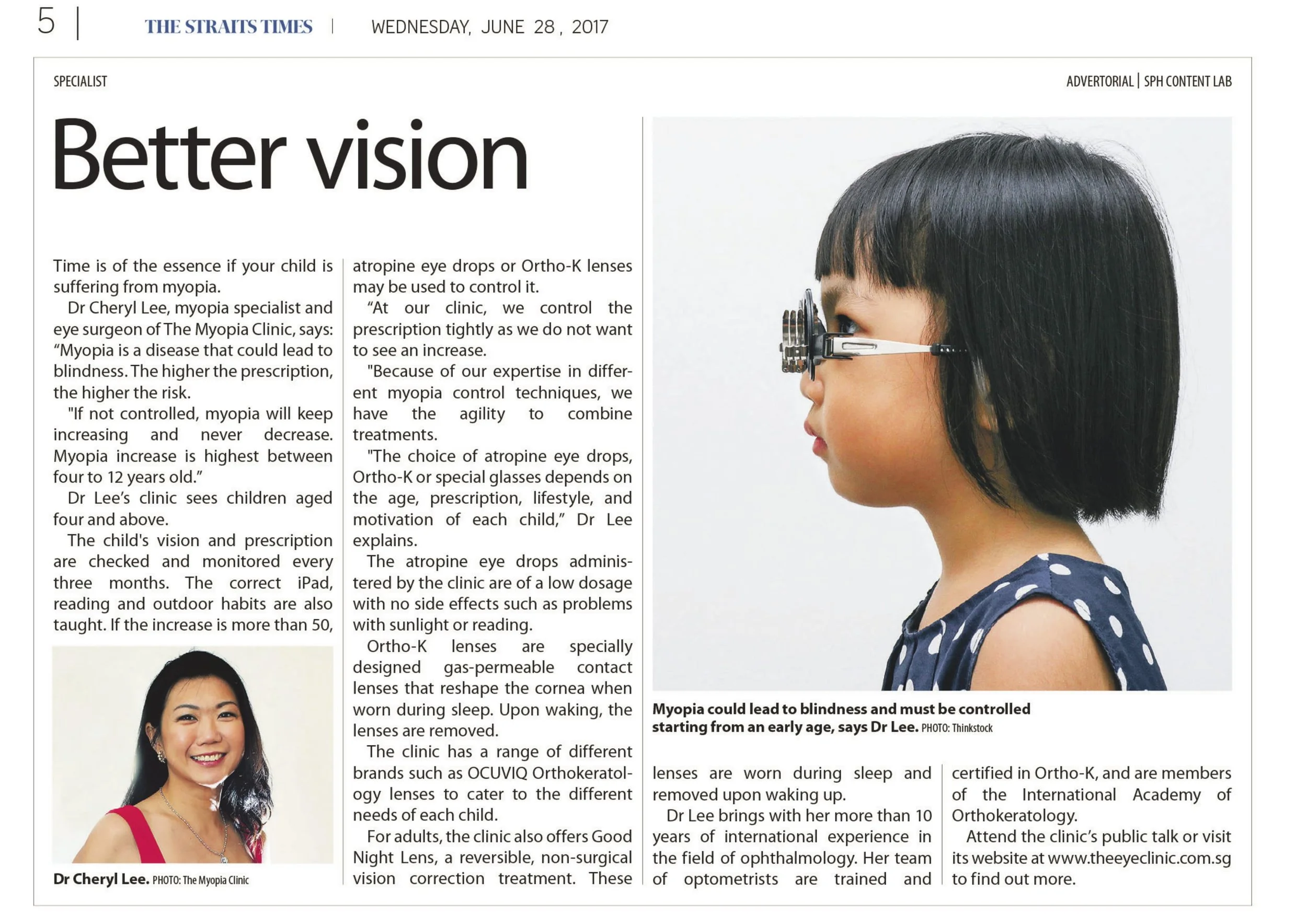
What Is the Best Myopia Control Treatment for Children?
Myopia (short-sightedness) is becoming increasingly common among children worldwide. In myopia, distant objects appear blurry because the eye grows longer than normal, causing light entering the eye to focus in front of the retina instead of directly on it. In Singapore, 80% at age 16 are myopic.
For many children, myopia gradually worsens every year as the eyes continue to grow. Myopia control treatments aim to slow the progression of myopia, helping to reduce the risk of developing high myopia later in life.
Parents often ask: what is the best myopia control treatment for children?
The answer depends on the individual child. Several evidence-based treatments are available, and the most appropriate option will depend on factors such as the child’s age, prescription, lifestyle, and rate of myopia progression.
Why Myopia Control Is Important
Myopia is not just about needing stronger glasses.
When myopia becomes high, the eye becomes longer and the risk of certain eye conditions later in life increases. These may include:
Retinal detachment
Myopic macular degeneration
Glaucoma
Because myopia usually progresses most rapidly during childhood, early treatment may help reduce these long-term risks.
Common Myopia Control Treatments for Children
Several treatments have been shown to help slow myopia progression. The most widely used options include atropine eye drops, orthokeratology lenses, and specially designed myopia control spectacles or contact lenses.
Atropine Eye Drops
Low-dose atropine eye drops are one of the most commonly prescribed treatments for myopia control.
These drops are usually used once daily at night. Low concentrations such as 0.01% to 0.05% atropine are typically used to reduce side effects while still helping to slow the progression of myopia.
Research studies have shown that low-dose atropine can significantly reduce the rate at which myopia worsens in many children.
Possible side effects for high dose atropine may include:
Mild light sensitivity
Slight pupil enlargement
Temporary difficulty focusing on near objects
Most children tolerate low-dose atropine well when the treatment is monitored by an eye care professional. Dr Cheryl Lee does not use high dose atropine.
Orthokeratology (Ortho-K)
Orthokeratology, often called Ortho-K, uses specially designed rigid contact lenses worn overnight.
During sleep, these lenses gently reshape the cornea so that the child can see clearly during the day without glasses or contact lenses.
In addition to correcting vision temporarily, orthokeratology also changes how light focuses on the retina. This optical effect may help slow the elongation of the eye and reduce the progression of myopia.
Ortho-K may be particularly suitable for:
Active children who play sports
Children who prefer not to wear glasses during the day
Children with progressively increasing myopia
Myopia Control Glasses or Contact Lenses
Specially designed spectacle lenses and soft contact lenses can also help slow myopia progression.
These lenses are designed to alter peripheral focus on the retina, which may reduce the signals that stimulate the eye to grow longer.
Myopia control glasses may be a good option for children who prefer wearing spectacles rather than contact lenses or eye drops.
Can Treatments Be Combined?
In some cases, eye doctors may recommend combining treatments.
For example, low-dose atropine eye drops may be used together with orthokeratology lenses or myopia control contact lenses. Combination therapy may provide additional benefits for some children, particularly those whose myopia is progressing rapidly. Dr Cheryl Lee gets good results with combination therapy.
The decision to combine treatments should always be made by an eye care professional after a thorough examination.
Lifestyle Habits That Support Myopia Control
In addition to medical treatments, certain lifestyle habits may help support healthy eye development. Dr Cheryl Lee will share with your child how to develop good eye habits.
Outdoor time
Research suggests that children who spend more time outdoors may have a lower risk of developing myopia.
Regular breaks from near work
Encouraging children to take breaks during reading or screen use may help reduce eye strain.
Regular eye examinations
Routine eye exams help detect changes in vision early so that appropriate treatment can be started.
While lifestyle habits alone may not stop myopia progression, they can support overall eye health.
When Should Myopia Control Start?
Myopia control treatments are started the moment myopia develops.
Dr Cheryl Lee has extensive professional and personal experience with myopia control. Dr Cheryl Lee has maintained perfect eye-sight.
Because eye growth occurs most rapidly during childhood, early intervention often provides the greatest benefit.
Which Myopia Control Treatment Is Best?
There is no single treatment that is best for every child.
The most appropriate treatment will depend on factors such as:
The child’s age
The level of myopia
How quickly the prescription is changing
Lifestyle and preferences
An eye doctor can assess these factors and recommend the most suitable option.
Summary
The best myopia control treatment for children depends on the individual child. Evidence-based options such as low-dose atropine eye drops,orthokeratology lenses, and myopia control spectacles or daily contact lenses can all help slow myopia progression.
Early treatment and regular monitoring are important for protecting long-term eye health.
Parents who notice their child’s glasses prescription increasing each year should consider scheduling a professional eye examination to discuss available myopia control options.
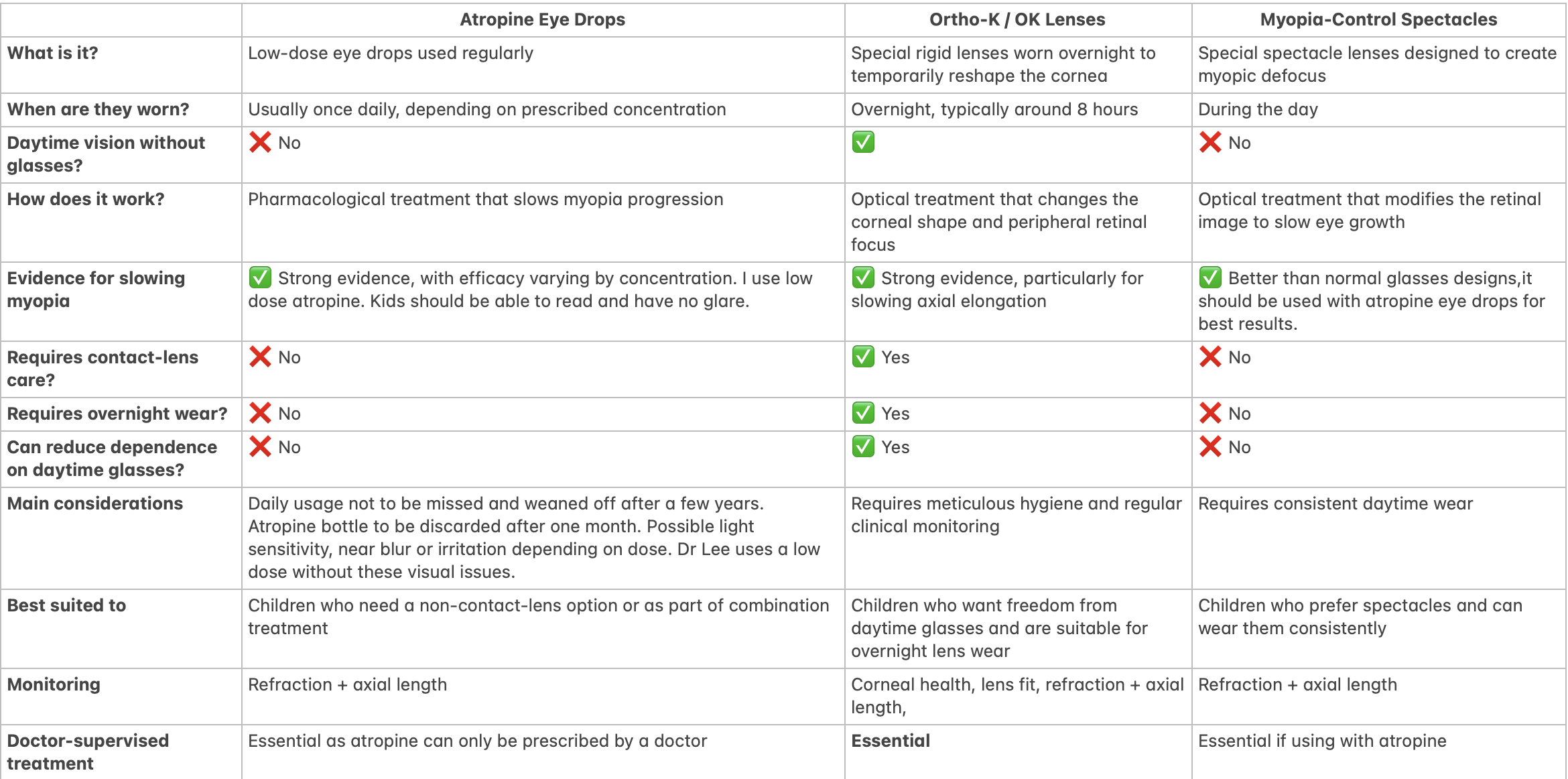
Comparison Chart of Atropine , OK lenses and Myopia Control Glasses
Dr Lee’s Perspective
There is no single best myopia-control treatment for every child.
As an ophthalmologist specialising in myopia management, I am often asked by parents: “Which is better — atropine, Ortho-K or myopia-control glasses?”
My answer is: it depends on the child.
All three approaches have evidence supporting their ability to slow myopia progression, but they work in different ways and suit different children. Current evidence suggests that orthokeratology is among the more consistently effective optical approaches, while atropine and specialised spectacle lenses can also be valuable options.
What matters to me is not simply whether a child can see clearly today. I want to understand what is happening to their eyes and how quickly their myopia is progressing.
I look beyond the prescription.
When I assess a child with myopia, I consider their age, prescription, rate of progression, axial length, family history, lifestyle and how realistic it is for them to follow a particular treatment.
For some children, Ortho-K is an excellent choice. The lenses are worn overnight and reshape the cornea temporarily, giving clear vision during the day while also helping to slow excessive axial eye growth. It can be particularly attractive for active children who do not want to wear glasses during the day.
For another child, myopia-control spectacles may be the better starting point — particularly when a child is not ready for contact lenses or when the family prefers a simpler daytime routine.
Atropine is another important tool in myopia management. Its effectiveness depends on the concentration used, and the choice of dose needs to be individualised. Higher concentrations can provide greater myopia-control effects but may also cause more side effects such as light sensitivity and difficulty with near vision.
Sometimes, one treatment is not enough.
Myopia is dynamic. A child who progresses despite treatment may need their management strategy reassessed.
In selected children, combining treatments can be appropriate. There is particularly good evidence for combining low-dose atropine with Ortho-K, where studies have demonstrated additional slowing of axial elongation compared with Ortho-K alone.
This is why I don't believe in a “one-size-fits-all” approach to myopia control.
Why I am particularly careful with Ortho-K
Ortho-K is not simply a contact-lens fitting.
It is an overnight medical contact-lens treatment that requires careful assessment of the child's eyes, precise lens fitting, attention to corneal health and regular follow-up.
For me, the question is not simply:
“Can we make your child see without glasses?”
It is:
“Is Ortho-K appropriate for this child, and are we controlling their myopia safely and effectively over time?”
That distinction is important.
I monitor the child's vision and, where appropriate, axial length — the length of the eye itself — because slowing the excessive elongation of the eye is a central goal of modern myopia management.
My philosophy
I don't prescribe a particular treatment because it is fashionable, convenient or because it worked for another child.
I prescribe the treatment I believe is right for that particular child.
Sometimes that is Ortho-K.
Sometimes it is myopia-control spectacles.
Sometimes it is atropine.
And sometimes, particularly in a rapidly progressing child, a combination approach deserves consideration.
My role as an ophthalmologist is to look at the bigger picture, explain the choices clearly to parents and monitor the child's eyes over time.
Because myopia control isn't just about getting a child out of glasses today.
It is about protecting their vision for the years ahead.