
MiSight vs Ortho-K vs Atropine: Which Myopia Control Treatment Is Best?
Several treatments are available to help slow the progression of myopia in children. The three commonly recommended options include MiSight contact lenses, orthokeratology (Ortho-K), and low-dose atropine eye drops.
Each treatment works in a different way, and the most suitable option depends on the child’s age, prescription, lifestyle, and how quickly the myopia is progressing.
MiSight Daily Disposable Contact Lenses
MiSight contact lenses are specially designed daily disposable soft contact lenses for children with myopia.
These lenses use a unique optical design that provides clear central vision while also creating a special focusing pattern on the retina that may help slow the growth of the eye.
Key features of MiSight lenses
Worn during the day and removed at night
Daily disposable lenses for convenience and hygiene
Designed to slow myopia progression while correcting vision
Suitable for many children with active lifestyles
MiSight lenses can be a good option for children who are comfortable wearing contact lenses during the day and prefers to wear glasses on some days and contacts on other days.
Orthokeratology (Ortho-K)
Orthokeratology lenses are specially designed rigid contact lenses worn overnight during sleep.
These lenses gently reshape the cornea while the child sleeps. When the lenses are removed in the morning, the child can see clearly during the day without glasses or contact lenses.
In addition to improving daytime vision, Ortho-K lenses may help slow myopia progression by changing how light focuses on the peripheral retina.
Key features of Ortho-K
Worn overnight while sleeping
Clear vision during the day without glasses
Slows myopia progression
Popular for active children and sports
Good even for adults who don’t want to wear contacts during the day because of dryness, allergies, water sports
Low-Dose Atropine Eye Drops
Low-dose atropine eye drops are a medication used to slow the progression of myopia.
The drops are usually applied once daily at night. They work by influencing the biological mechanisms that control eye growth.
Atropine treatment is often used for children whose myopia is increasing steadily each year.
Key features of atropine treatment
Eye drops used once daily
Does not require contact lens wear
Often used in younger children
Can be combined with other myopia control treatments
Low-dose atropine is generally well tolerated, though some children may experience mild light sensitivity or slight difficulty focusing at near.
Choosing the Best Option for Your Child
The best myopia control treatment varies for each child. Factors that influence the choice include:
The child’s age
The level of myopi
How quickly the prescription is changing
Lifestyle and daily activities
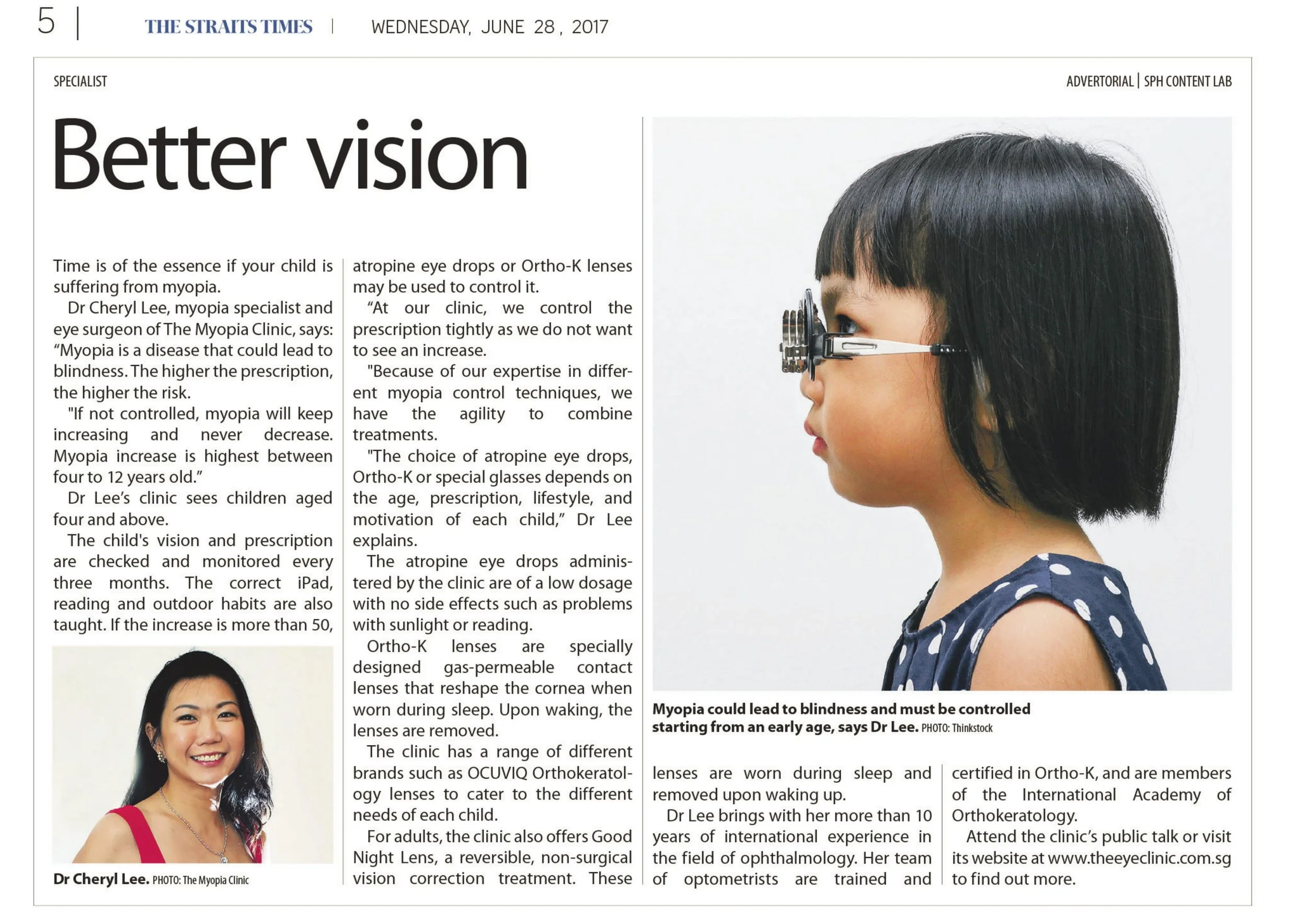
Dr Cheryl Lee may recommend combining treatments to achieve better control of myopia progression.
A comprehensive eye examination can help determine the most appropriate option for your child.