

What is the EVO VIVA ICL?
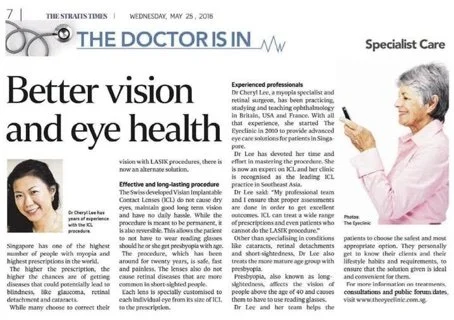
EVO Viva ICL for Presbyopia
See far. See near. Without permanently reshaping your cornea.
Around our mid-40s, something changes.
You may still see beautifully in the distance with your contact lenses or glasses — but suddenly the menu is too close, your phone needs to move further away, and reading in dim light becomes surprisingly difficult.
This is presbyopia.
It is a natural part of ageing, but it changes the conversation about vision correction.
For appropriately selected patients who have both myopia and presbyopia, EVO Viva ICL offers another possibility: correcting vision with a lens placed inside the eye, while leaving the cornea untouched and retaining the natural crystalline lens.
[Am I suitable for EVO Viva ICL?]
Presbyopia changes the conversation
When I assess someone in their 40s or 50s for vision correction, I am not simply looking at their spectacle prescription.
I want to know how they actually use their eyes.
Do you drive frequently at night?
Spend hours on a computer?
Read extensively?
Play golf or tennis?
Travel often?
Need very precise distance vision for your work?
And perhaps most importantly:
What do you want your vision to feel like?
Presbyopia is not simply about needing reading glasses. It is about balancing distance, intermediate and near vision in a way that suits your life.
That is why I believe vision correction at this stage of life deserves particularly thoughtful planning.
What is EVO Viva ICL?
EVO Viva ICL is an implantable lens designed for people who have myopia together with presbyopia.
The lens is placed inside the eye, behind the iris and in front of your natural crystalline lens.
Unlike corneal laser procedures, the shape and thickness of your cornea are not permanently altered.
And unlike lens replacement surgery, your natural crystalline lens is not removed.
For me, that distinction matters.
Why ICL for presbyopia interests me
I have spent many years working with implantable contact lenses, and my philosophy has become increasingly simple:
Preserve healthy anatomy whenever it is sensible to do so.
I do not perform LASIK.
That is a deliberate professional choice.
I have chosen not to permanently reshape the cornea when, for a suitable patient, I can correct their vision while leaving it untouched.
The same philosophy becomes particularly interesting when we reach presbyopia.
If your natural crystalline lens is still healthy and clear, I do not believe that reaching your 40s or 50s automatically means it should be removed simply because you have begun to need reading glasses.
For an appropriately selected patient, EVO Viva ICL gives us another option:
correct the vision, preserve the cornea and retain the natural lens.
Your eyes should not be treated as though today is all that matters.
The eyes I operate on today may need cataract surgery many years from now.
That future matters to me when I make decisions with you today.
Preserving the cornea and natural lens where appropriate means we are thinking not only about freedom from glasses now, but also about the eye you will have in the decades ahead.
ICL is not simply for people who cannot have LASIK
This is something I feel quite strongly about.
ICL is sometimes described as the procedure offered when someone has very high myopia, a thin cornea or is otherwise unsuitable for laser vision correction.
That is not how I think about it.
For a patient whose eyes are suitable for ICL, choosing an implantable lens can itself be a considered approach to vision correction.
The cornea is not permanently reshaped.
The natural crystalline lens remains in place.
And the ICL can be removed if there is a medical reason to do so in the future.
ICL is not a compromise. It is a considered choice.
[Read why I choose ICL rather than LASIK →]
With presbyopia, the details matter even more
Successful ICL surgery is not simply about placing a lens inside the eye.
Lens selection matters.
The anatomy of your eye matters.
Your visual expectations matter.
Before recommending an EVO Viva ICL, I perform detailed measurements to understand the dimensions and anatomy of the eye.
Where appropriate, this includes ultrasound biomicroscopy (UBM), which allows me to examine structures inside the eye that cannot be assessed simply from your glasses prescription.
These measurements help me decide whether an ICL is appropriate and, if so, plan the lens and surgery for that particular eye.
Two patients with exactly the same spectacle prescription may not necessarily require exactly the same approach.
What kind of vision can I expect?
This is probably the question I am asked most.
And I prefer not to promise patients simply:
“You will never need glasses again.”
Presbyopic vision is more complex than that.
EVO Viva ICL is designed to provide a broader range of vision for appropriately selected patients with myopia and presbyopia, reducing dependence on glasses for everyday activities.
But every eye — and every person's visual demands — is different.
During your consultation, I want to understand what matters most to you: distance clarity, computer vision, reading, night driving or simply being able to wake up and function without immediately searching for your glasses.
The aim is not a slogan such as no glasses.
The aim is comfortable, useful vision that works for your life.
One of the patients I have never forgotten
Many years ago, I removed an ICL from a German lady who had received one of the earliest implantable contact lenses approximately 25 years previously.
By then she had developed presbyopia and wanted her vision addressed differently.
When I removed her ICL, it slipped out smoothly.
After approximately 25 years inside her eye, I did not see the sort of scarring one might imagine from something that had been there for so long.
That experience stayed with me.
We often describe ICL as reversible.
For me, actually removing a lens after approximately 25 years made that concept very real.
It is one of the reasons preserving future options remains an important part of how I think about refractive surgery.
Who might consider EVO Viva ICL?
EVO Viva ICL may be worth discussing if you:
are short-sighted and have begun to develop presbyopia;
would like to reduce your dependence on distance and reading glasses;
have a healthy, clear natural crystalline lens;
prefer an approach that does not permanently reshape the cornea;
would like to retain your natural lens where medically appropriate; or
simply want to understand whether ICL is an option before deciding on vision correction.
Suitability cannot be determined from age or spectacle prescription alone.
The health, dimensions and anatomy of the eye must be examined carefully before I recommend surgery.
Book an ICL suitability assessment
My experience with ICL
I have worked with implantable contact lenses for more than two decades and have been involved in international EVO ICL meetings, education and discussions with surgeons from around the world.
I am also a member of the international EVO ICL Expert Panel.
But experience in ICL surgery is not simply about how many lenses someone has implanted.
Over the years, I have learned that patient selection, detailed measurements, lens selection, surgical technique and knowing when not to operate are all equally important.
EVO Viva is a newer development in ICL technology.
The principles I bring to it are not new:
measure carefully, select carefully, operate carefully and follow the patient personally.
Read about Dr Cheryl Lee's ICL experience
What happens if I am suitable?
Your journey begins with a detailed ICL assessment.
01 — Your eyes
We assess your prescription, cornea, natural lens and the internal anatomy of your eyes.
02 — Your life
We discuss how you use your vision — driving, reading, computers, sport, travel and everyday life.
03 — Your options
I explain what I believe is appropriate for your eyes, including situations where I do not think ICL is the right choice.
04 — Your surgery
If you decide to proceed, your lens and surgery are planned for your individual eyes.
05 — Your follow-up
I personally follow my surgical patients after their procedure.
Freedom from glasses is wonderful.
Preserving your eyes is even more important.
Vision correction is elective surgery.
There should be time to ask questions, understand your choices and decide whether a procedure feels right for you.
My role is not simply to offer you a lens.
It is to understand your eyes, explain your options and help you make a decision you feel comfortable with — not only for your vision today, but for the years ahead.
Dr Cheryl Lee
The Eye Clinic by Dr Cheryl Lee
Singapore
Find out if EVO Viva ICL may be suitable for you
“Over 45 and beginning to need reading glasses? Learn about EVO Viva ICL for presbyopia →”
What is the procedure like?
An ICL story I have never forgotten
Many years ago, I met a German lady who had received one of the earliest implantable contact lenses approximately 25 years earlier.
By the time she came to see me, her eyes — and her visual needs — had naturally changed. She had developed presbyopia and wanted to explore a different solution for her vision.
This meant removing the ICL that had been sitting quietly inside her eye for around a quarter of a century.
I remember the moment very clearly.
The lens slipped out smoothly.
After approximately 25 years inside the eye, I was struck by how straightforward it was to remove and by the absence of the sort of scarring one might imagine after something had remained inside the eye for so long.
As surgeons, we often use the word “reversible” when we talk about ICL.
But that experience made the word very real for me.
I had removed an ICL after approximately 25 years. The lens could come out easily no scarring at all. The cornea had never been reshaped.
That patient reinforced something that has become central to the way I think about refractive surgery.
Your eyes will change throughout your lifetime. The treatment we choose today should, wherever possible, respect the eye you may have many years from now.
That is one of the reasons I value ICL: not simply for the vision it can provide today, but for the anatomy it allows us to preserve for tomorrow.
— Dr Cheryl Lee
Benefits of EVO VIVA ICL versus Lasik

No dry eyes
In Lasik, layers of the cornea are removed so nerves that produce tears that are in the cornea are removed too. That’s why the eyes become dry. Not great when we have to work with devices and with women, dry eyes worsen with menopause.

Long term stable vision
The cornea remains strong so the vision remains strong.
In Lasik as layers of the cornea are removed, the cornea’s biomechanics is weaker and hence the myopia can return with time.

No more reading glasses
The new EVO VIVA ICL corrects presbyopia too.Two in One Lens.
Lasik corrects one eye for near and one eye for far. Viva ICL will not make you compromise. You have far vision and near vision in both eyes. Much better quality of vision and safer for driving and less tiring for reading.
Much less painful than Lasik, many have only mild discomfort
Way quicker recovery
My patients do not have an eye patch after surgery. You are walking, shopping and going home independently after surgery.
Why ? Because the 2mm incision is tinier than any other vision correction procedure