
ICL Sizing with UBM Ultrasound
For me, good ICL surgery begins before the surgery.
Patients often ask me:
“What are the risks of ICL?”
It is an important question.
But the question I ask myself as their surgeon is slightly different:
“Which of those risks can we prevent?”
One of the most important things we can control in ICL surgery is choosing an appropriately sized lens for the individual eye.
That is why I do something additional for my ICL patients.
Before surgery, we perform ultrasound biomicroscopy — UBM — as part of my ICL sizing protocol.
And after surgery, we measure again.
Because I don't simply want to know that your ICL is in your eye.
I want to know that it is sitting beautifully inside your eye.
There is no such thing as a standard eye
Two people can have exactly the same spectacle prescription and yet have very different anatomy inside their eyes.
An ICL sits behind the iris and in front of your natural crystalline lens.
So when I plan ICL surgery, your spectacle prescription is only one part of the story.
I want to understand the space in which that lens will actually sit.
UBM — ultrasound biomicroscopy — allows us to look beyond the structures we can see from the outside and examine the anatomy behind the iris.
This gives me additional information about your individual eye before choosing the ICL size.
I don't believe in treating an eye as a set of numbers on a standard formula.
I want to understand the eye those numbers belong to.
Why does ICL size matter?
Once an ICL is inside the eye, there should be an appropriate space between the ICL and your natural crystalline lens.
We call this the vault.
I often explain it very simply to my patients:
I don't want your ICL sitting too high.
And I don't want it sitting too low.
If the ICL is excessively large for the anatomy of the eye, the vault may be too high.
If it is too small, the vault may be too low.
Either extreme can create problems.
An excessively high vault can contribute to crowding within the front of the eye and may affect eye pressure.
An excessively low vault may bring the ICL too close to the natural crystalline lens, which is one of the factors associated with cataract formation.
So rather than simply discussing these risks with you, my approach is:
Let's do everything reasonably possible to reduce the risks we can control.
That begins with sizing.
Why I use UBM ultrasound
There are established methods and formulas for selecting ICL size.
In my own practice, I choose to go further.
I perform UBM as part of the pre-operative assessment for every ICL patient.
UBM allows us to image structures behind the iris and gives me additional anatomical information that cannot be obtained simply by measuring the visible dimensions of the front of the eye.
It takes additional time.
It requires specialised equipment and experience.
But I believe that when I am placing a lens inside someone's eye, additional information that helps me understand that eye is worth having.
I also do not stop at the day of surgery. About a month afterwards, we measure the vault again, using a scan that does not involve the water used in UBM, to confirm that the lens is sitting where we planned and that the size was right for your eye.This is not an optional extra in my ICL practice. It is part of my standard.
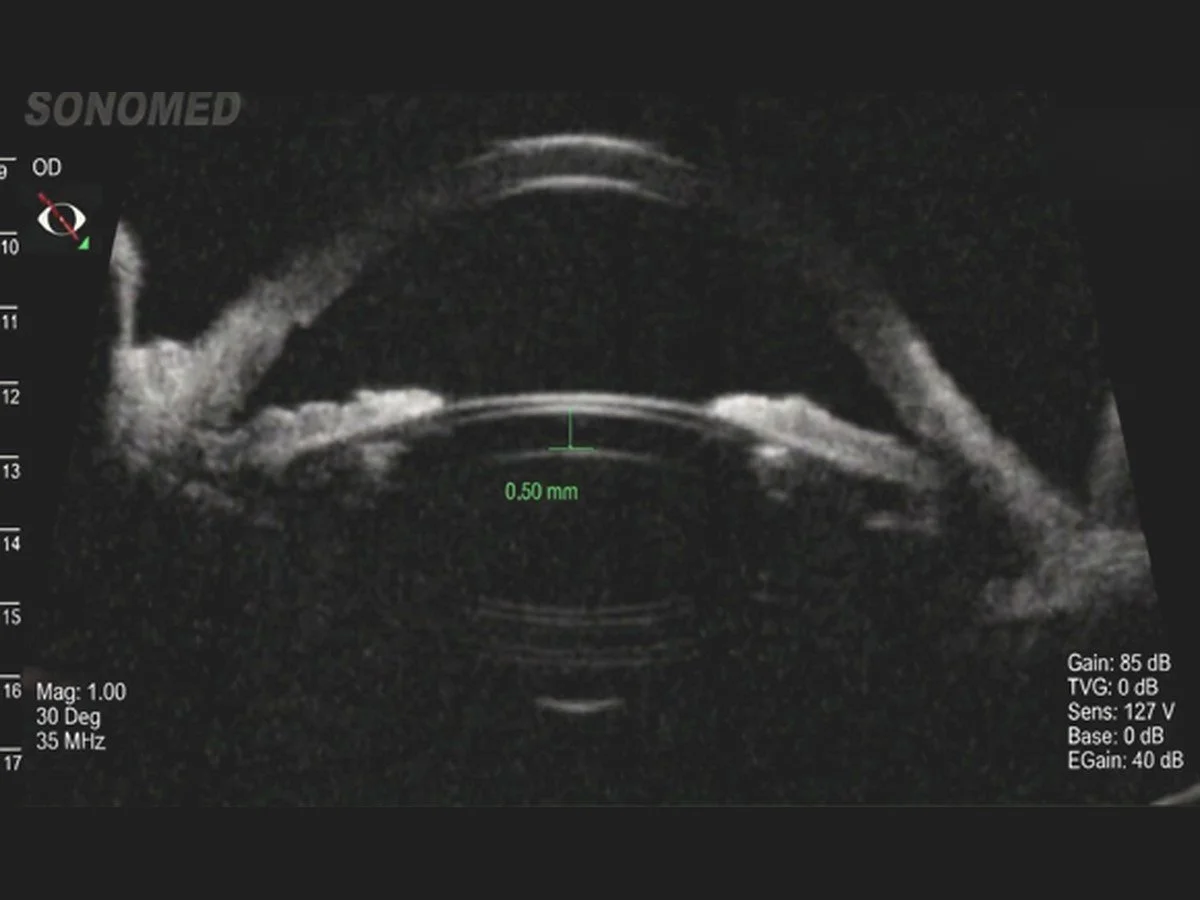
A scan from one of my patients, showing an appropriately sized ICL. The vault, the space between the ICL and the natural lens, measures 0.50 mm.
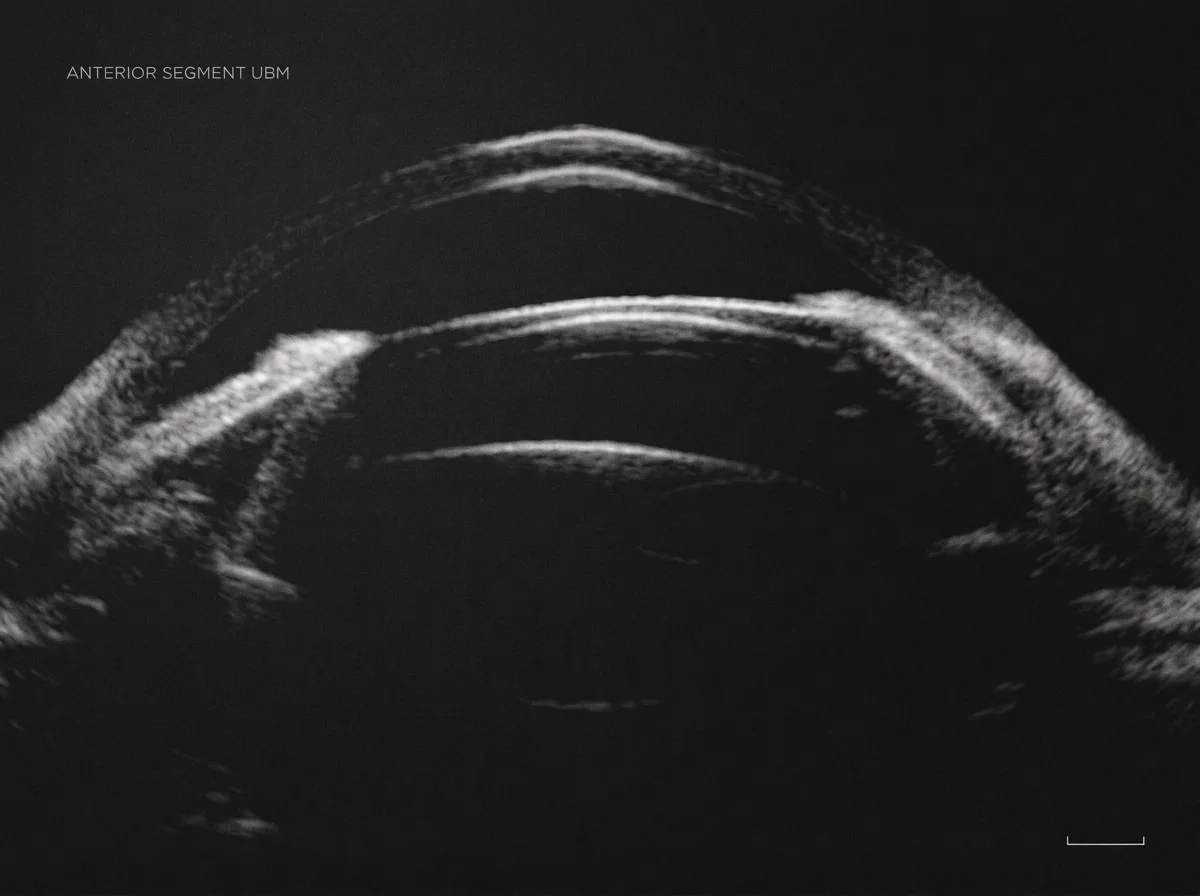
A scan from a patient referred to me with an ICL that was too large for the eye. The vault is excessive, crowds the front of the eye and may affect eye pressure.
Dr Lee’s Perspective
Patients often ask me, “What are the risks of ICL?”
I tend to think about it slightly differently.
Can we prevent the risk?
That is why I am so particular about ICL sizing. I want to understand the anatomy of your eye before surgery, choose the lens size carefully, and then check the result afterwards.
Because the best complication is the one we never have to treat.
— Dr Cheryl Lee
“But Dr Lee, isn't ICL surgery very safe?”
For appropriately selected patients, modern EVO ICL surgery has an excellent safety profile.
But “safe” does not mean that details no longer matter.
In fact, I think the opposite is true.
Modern technology allows us to be increasingly precise.
So I believe we should use that precision.
The operation itself may take me only a few minutes.
The planning behind those few minutes should never be rushed.
My approach to ICL is prevention
I have spent many years performing ICL surgery, and experience changes the questions you ask.
Early in a surgeon's career, it is natural to ask:
“How do I manage this complication?”
With experience, I think the more important question becomes:
“Could I have prevented it?”
That philosophy influences the way I practise ICL surgery today.
I want to select the right patient.
I want to understand the health of the eye.
I want detailed measurements.
I want to understand the internal anatomy.
I want to choose the ICL size carefully.
And after surgery, I want to check that the result is what we planned.
Because the best complication is the one we never have to treat.
This is my standard for ICL surgery
UBM is not something I reserve only for difficult cases.
It is part of how I choose to plan my ICL patients.
Not because every patient is complicated.
But because every patient's eyes are individual.
When someone trusts me with their vision, I want to have as much useful information as possible before I operate.
And afterwards, I want to know that the lens is sitting where I intended it to sit.
That takes a little more time.
For me, it is worth it.
Your ICL journey starts with careful planning
If you are considering ICL, your first step is not surgery.
It is finding out whether your eyes are suitable.
We assess the depth and health of the eye, your prescription and your individual anatomy before I make a recommendation.
If you are suitable and decide to proceed, detailed ICL measurements — including my UBM sizing protocol — become part of planning your surgery.
Your operation may be short.
The thought behind it is not.