
Vision Correction for Thin Corneas
Been Told Your Corneas Are Too Thin for LASIK?
This is often how patients first discover ICL.
Perhaps you were excited about finally getting rid of your glasses.
You went for a laser vision correction assessment — only to be told:
“Your corneas are too thin for LASIK.”
It can feel disappointing.
But I would look at it differently.
A thin cornea does not necessarily mean that you cannot have vision correction.
It means we need to think about a different way of correcting your vision — one that does not require us to remove corneal tissue.
For appropriately selected patients, this is where EVO ICL can be particularly interesting.
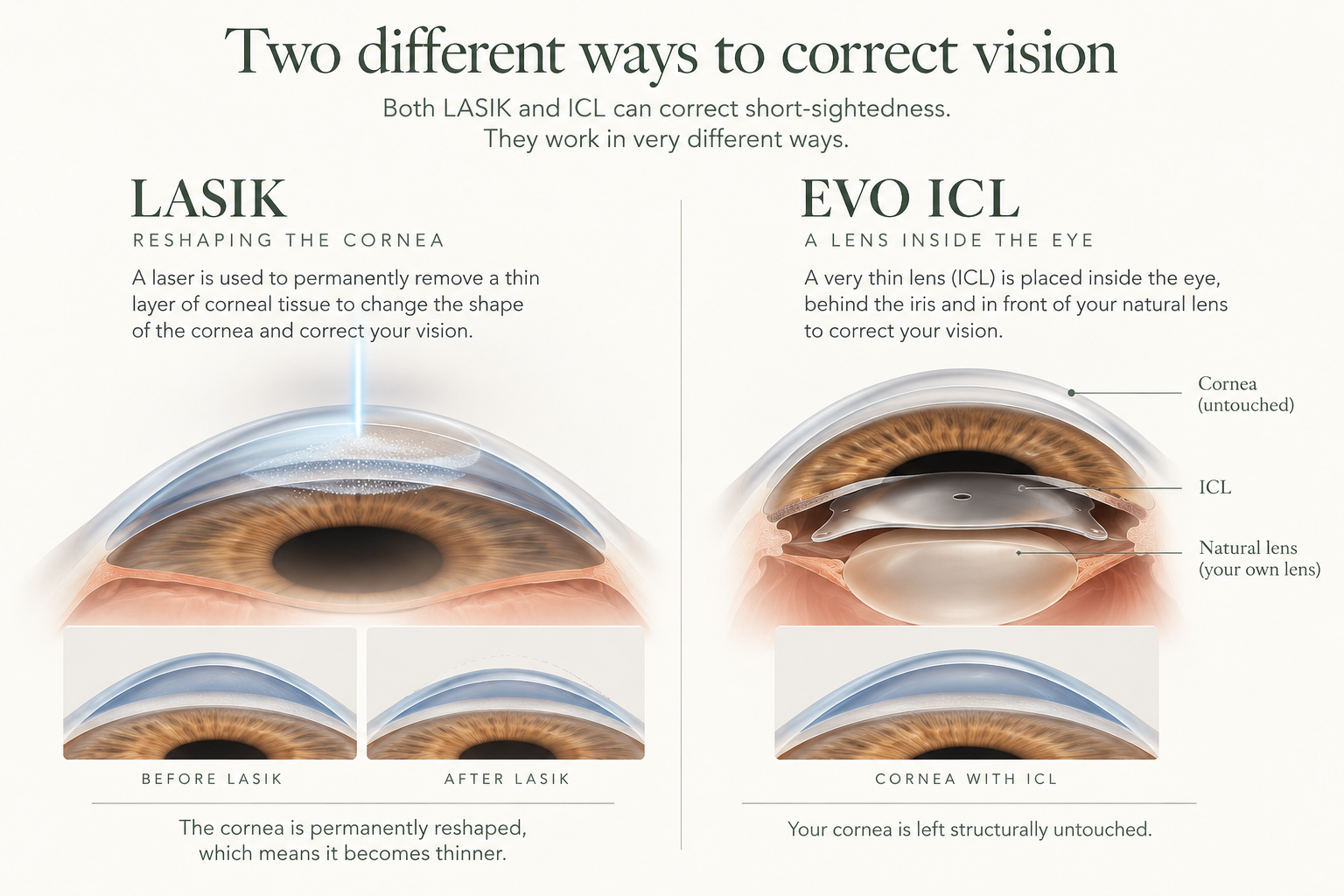
An ICL corrects your prescription with a lens placed inside the eye rather than by permanently reshaping the cornea.
A thin cornea may have led you to discover ICL. For me, preserving the cornea is one of the reasons I chose to specialise in it.
Why does corneal thickness matter?
LASIK corrects myopia by using a laser to permanently reshape the cornea.
I sometimes explain this to my patients by thinking of the cornea a little like kueh lapis or mille-feuille.
It has thickness.
To correct the prescription with laser, corneal tissue has to be removed and the shape of the cornea changed.
The higher the correction required, the more tissue may need to be altered.
So if your cornea is already thin, there may not be sufficient tissue for a surgeon to consider LASIK appropriate.
But there is another point I think is worth understanding:
You do not have to start with a thin cornea for corneal thickness to matter.
Laser vision correction itself reduces corneal thickness because tissue is permanently removed during treatment.
This is one of the reasons I have chosen a different approach in my own refractive surgery practice.
DR LEE'S PERSPECTIVE
I don't only think about whether I can correct your prescription.
I think about what I have to change in your eye to achieve it.
If I can correct the vision of an appropriately selected patient with an ICL while leaving the cornea structurally untouched, that is an approach I prefer.
Preserving healthy anatomy matters to me.
— Dr Cheryl Lee
So what happens if your cornea is too thin for LASIK?
First, don't assume that being unsuitable for LASIK means being unsuitable for vision correction.
The question becomes:
Is there another way to correct your prescription without removing more corneal tissue?
For some patients, the answer may be EVO ICL.
Instead of reshaping the cornea, a very thin lens is placed inside the eye, behind the iris and in front of your natural crystalline lens.
Your prescription is corrected by the lens.
Your cornea is left untouched.
[Discover how EVO ICL works →]
ICL is not simply the alternative when LASIK says no
This is an important distinction.
ICL is sometimes presented as the option for patients who cannot have LASIK because their corneas are thin or their prescriptions are very high.
That is not how I think about it.
I do not perform LASIK.
That is a deliberate professional choice.
I understand both technologies, and for patients whose eyes are suitable for ICL, I prefer an approach that corrects the prescription without permanently removing or reshaping corneal tissue.
The fact that ICL can also be removed if medically necessary in the future is another important part of that philosophy.
For me, ICL is not a second choice after LASIK. It is a different way of thinking about vision correction.
What about high myopia and thin corneas?
This becomes particularly relevant if you have both high myopia and relatively thin corneas.
Higher laser corrections generally require greater alteration of the cornea.
Singapore has many patients with significant myopia, so this is a conversation I have frequently in my clinic.
With ICL, we are not trying to remove increasing amounts of corneal tissue to correct a higher prescription.
The correction comes from the lens placed inside the eye.
For appropriately selected patients with high myopia, that can make ICL particularly worth considering.
[Read about EVO ICL for high myopia →]
What about dry eyes?
This is another reason I think carefully about the cornea.
The cornea contains an extraordinary network of nerves that contributes to the normal regulation of the ocular surface and tears.
Corneal laser procedures affect corneal nerves, and dry-eye symptoms are a recognised consideration after laser vision correction.
ICL does not reshape the cornea in this way.
This can be particularly relevant for someone who already has dry-eye symptoms or has struggled with contact lenses.
As a dry-eye specialist as well as an ICL surgeon, I look at the ocular surface carefully when assessing patients for vision correction.
Good vision is not simply about achieving the right prescription. Your eyes also need to feel comfortable.
And if you are suitable, sizing matters
Once I have established that your eyes are suitable for ICL, another important part of my planning begins.
What size ICL is right for your eye?
This matters because I do not want the lens sitting too high or too low once it is inside the eye.
That is why UBM ultrasound forms part of my pre-operative ICL sizing protocol.
It allows us to obtain additional information about the anatomy behind the iris before surgery.
And after surgery, we check the ICL and measure its position.
I don't simply want an ICL to fit.
I want it to fit your eye beautifully.
[Why I use UBM ultrasound for ICL sizing →]
Let's look at your eyes
If you have been told that your corneas are too thin for LASIK, don't think of yourself as having “failed” a vision correction assessment.
You have simply learnt something important about your eyes.
Come and let me look at them.
We can discuss why laser surgery was not recommended, whether ICL is suitable and what I would choose for your eyes — and why.
There is no obligation to have surgery.
The first step is simply understanding your eyes.
Dr Cheryl Lee