
High Myopia & ICL
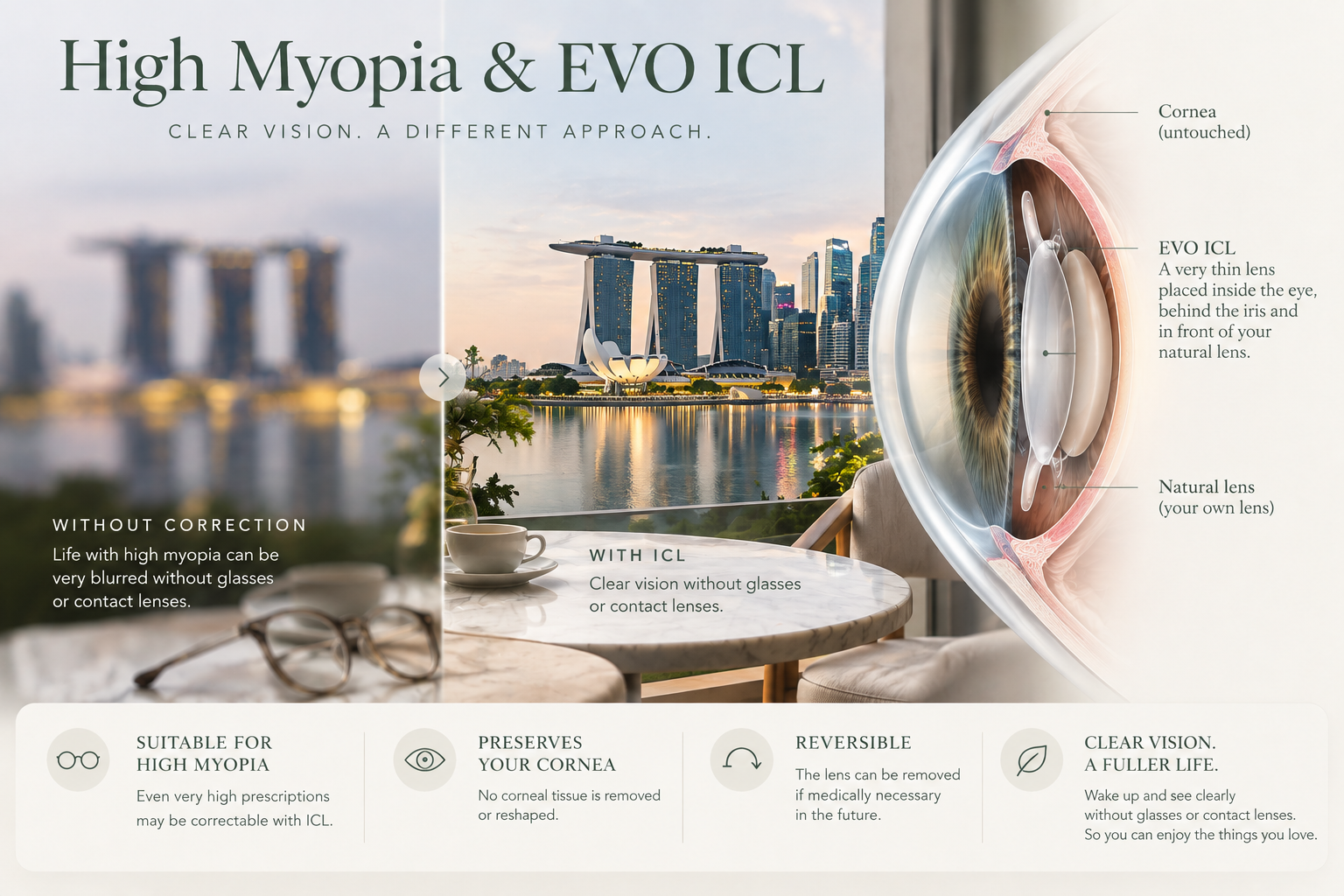
When your prescription is high, I believe we need to think about more than simply getting rid of your glasses.
If you have high myopia, you probably don't need me to explain what it feels like.
You know what it is like to wake up and reach immediately for your glasses.
You know how thick lenses can become.
You may have worn contact lenses for years simply because you prefer them to your glasses.
And without either of them, the world can be extraordinarily blurred.
For many of my highly myopic patients, the idea of waking up and simply being able to see is quite extraordinary.
But when I assess someone with high myopia, correcting the prescription is only part of my job.
I want to understand the eye behind that prescription.
High myopia is more than a number
High myopia is generally defined as short-sightedness of around -6.00 dioptres (600 degrees) or more.
But I don't think of a highly myopic patient simply as someone with a large spectacle prescription.
A highly myopic eye is anatomically different.
As myopia increases, the eye is usually longer. This is why high myopia is associated with a greater lifetime risk of certain eye conditions, including retinal tears and retinal detachment, glaucoma, myopic macular changes and cataract.
So when someone comes to see me wanting freedom from their -8.00, -10.00 or even higher prescription, I don't begin by asking:
“How do we get rid of your glasses?”
I begin with:
“Are your eyes healthy?”
DR LEE'S PERSPECTIVE
Your prescription tells me how blurred your vision is.
It doesn't tell me whether your eye is healthy.
Before I think about vision correction in a highly myopic patient, I want to examine the retina, optic nerve and the rest of the eye carefully.
Because removing your glasses does not remove the risks associated with having a highly myopic eye.
Correcting myopia and caring for a myopic eye are two different things. I believe in doing both.
— Dr Cheryl Lee
Why I choose ICL for high myopia
High prescriptions are where the difference between ICL and corneal laser vision correction becomes particularly interesting.
Laser vision correction corrects myopia by permanently reshaping the cornea.
The amount of corneal tissue affected depends partly on the amount of correction required.
With ICL, we take a fundamentally different approach.
We correct the prescription with a lens inside the eye rather than by permanently reshaping the cornea.
The ICL sits behind the iris and in front of your natural crystalline lens.
Your cornea remains structurally untouched.
For a patient with high myopia who is anatomically suitable for ICL, this is one of the reasons I find ICL particularly compelling.
ICL isn't simply for patients who cannot have LASIK
This distinction matters to me.
You may have been told that ICL is something to consider because your prescription is “too high” for LASIK.
That may be how you first discovered ICL.
But it is not how I think about the procedure.
I do not perform LASIK.
That is a deliberate professional choice.
For patients whose eyes are suitable for ICL, I prefer correcting the prescription without permanently removing or reshaping corneal tissue.
And with high myopia, where the amount of correction required is greater, preserving the cornea becomes particularly relevant to my decision-making.
Your high prescription may have led you to discover ICL. Preserving your cornea is one of the reasons I chose to specialise in it.
[Why I choose ICL rather than LASIK →]
“But my prescription is very high. Can I still have ICL?”
Very likely and it is the only technology that can , safely.
And this is one of the remarkable aspects of ICL.
I have treated patients with prescriptions around 2600 degrees and beyond, but the number on your glasses prescription does not determine suitability on its own.
Before recommending ICL, I need to know whether there is sufficient space inside your eye for the lens.
I also need to understand the health of your eye.
That means looking beyond your prescription.
A very high prescription does not automatically mean yes. And it does not automatically mean no.
Your eyes need to be examined properly.
First, I check whether your eye is suitable
My ICL assessment starts with something very fundamental:
Is there enough space inside your eye for an ICL?
We assess the anterior chamber depth and other anatomical measurements.
But in a highly myopic patient, I also want to know much more.
I examine the retina.
I assess the optic nerve and glaucoma risk.
I look at the cornea.
I consider your dry-eye status.
And I want to understand your visual needs and expectations.
Only once I am comfortable with the health and anatomy of your eyes do we move on to planning your ICL.
Then comes something I am particularly meticulous about: ICL sizing
Once I know that an eye is suitable for ICL, I want to choose the lens carefully.
An ICL should not be too large.
And it should not be too small.
I use UBM ultrasound as part of my pre-operative ICL sizing protocol for every patient to obtain additional information about the anatomy behind the iris.
After surgery, we measure again and assess how the ICL is sitting inside the eye.
Why?
Because I don't simply want to know what complications can occur.
I want to ask which of them we can reasonably try to prevent.
[Why I use UBM ultrasound for ICL sizing →
Correcting high myopia does not make the eye “not myopic”
This is something I particularly want my highly myopic patients to understand.
After ICL surgery, you may wake up and see beautifully without your thick glasses.
But anatomically, you still have a highly myopic eye.
ICL corrects the focus of your vision.
It does not shorten an elongated eye or remove the lifetime retinal, glaucoma and other risks associated with high myopia.
That means looking after your eyes remains important even when you can see perfectly without glasses.
Freedom from glasses should never mean forgetting about the health of the eye behind them.
Dr Cheryl Lee is a big advocate of myopia prevention and control.
‘
If you are myopic, get your children checked and controlled ASAP and I promise you will not regret it’
And this is why I care so much about preventing myopia in children
There is another side to this story that is very personal to me.
I I spend part of my practice helping adults with high myopia see without glasses.
But I spend another part trying to prevent children from ever reaching these prescriptions.
We cannot change the fact that an adult already has a long, highly myopic eye.
But with children today, we have evidence-based treatments that can slow myopia progression.
That matters because myopia control is not simply about giving a child thinner glasses.
The less myopia a child develops, the better we hope their long-term eye-health risk profile will be.
This is why myopia control has become such an important part of my practice.
And as a mother, it is something I feel particularly strongly about.
[Why myopia control matters →]
From childhood myopia to adult eye care
One of the things I love about ophthalmology is that I can look after someone's eyes through very different stages of life.
For a child, my priority may be slowing myopia.
For a young adult with high myopia, it may be assessing whether ICL can give them freedom from glasses.
Years later, it may be monitoring their retina, glaucoma risk or eventually treating a cataract.
The prescription may change. My responsibility for the health of the eye does not.
If you have high myopia, let's start with your eyes
Perhaps your prescription is -7.00.
Perhaps it is -10.00.
Perhaps it is considerably higher.
The number matters.
But it isn't the first thing I want to know.
I want to know whether your eyes are healthy.
I want to understand their anatomy.
And then, if you are suitable for ICL, we can talk about how we might give you the freedom from glasses that you have perhaps imagined for years.
The goal is not simply to see without glasses.
It is to see well — and to continue looking after
the eyes behind that vision.
Dr Cheryl Lee
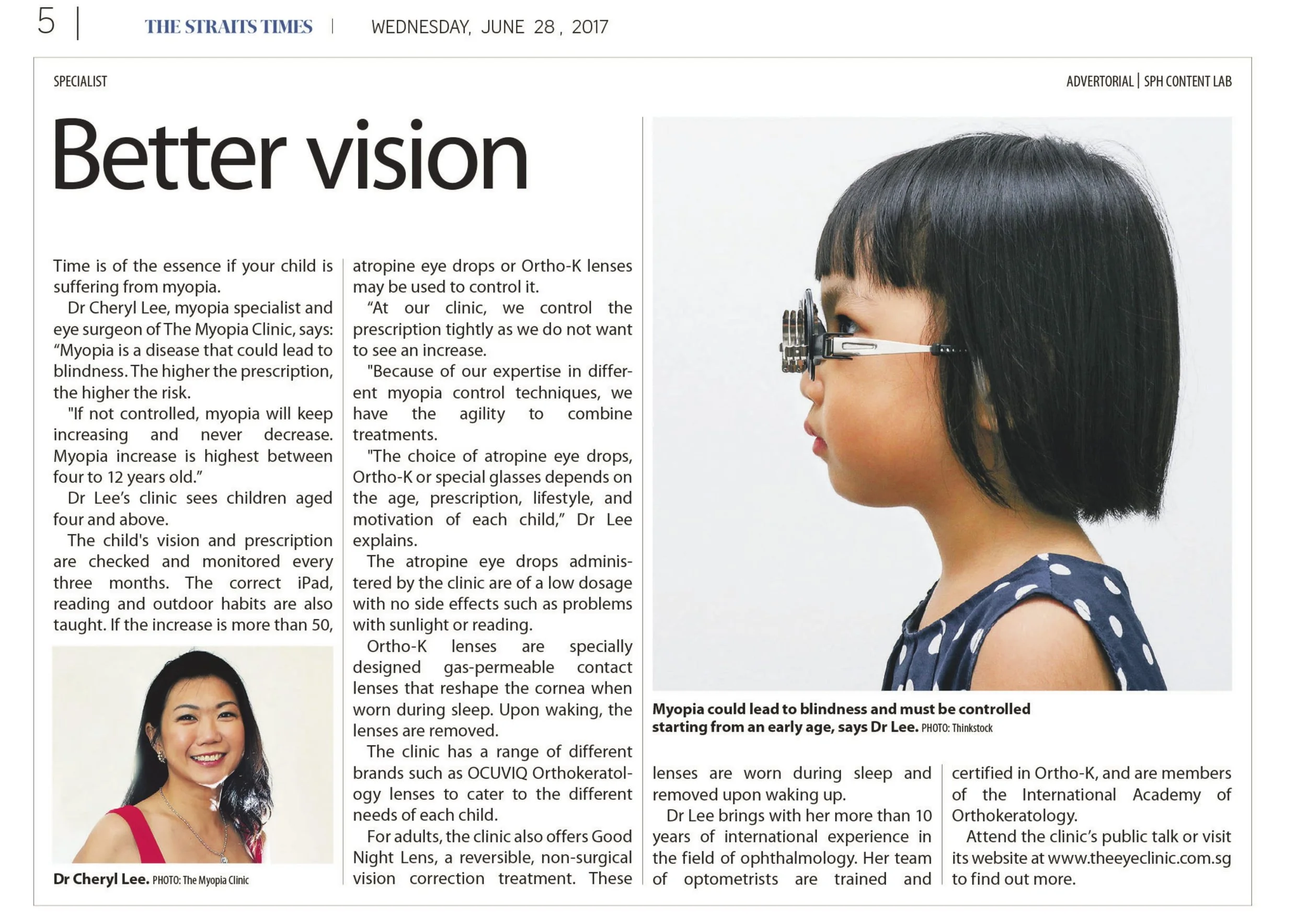
Why myopia control matters
When I see an adult with -8.00, -10.00 or even higher myopia, I am reminded why I care so much about controlling myopia when children are young.
We cannot undo the growth of an eye that has already become highly myopic.
But when a child is still growing, we have an opportunity to try to slow the progression of myopia and reduce how myopic that child eventually becomes.
And that matters for much more than the thickness of their glasses.
Higher levels of myopia are associated with a greater lifetime risk of retinal detachment, myopic macular disease, glaucoma and cataract.
So when I talk to parents about myopia control, my goal is not simply:
“Let's stop your child's prescription from getting higher.”
I am thinking much further ahead.
What can we do now to give these eyes the best possible future?
That may involve specially designed contact lenses, Ortho-K, myopia-control spectacles or other evidence-based approaches, depending on the individual child.
I use the same philosophy here that guides much of my practice:
If there is something we can reasonably do today to reduce a problem tomorrow, I believe it is worth considering.