
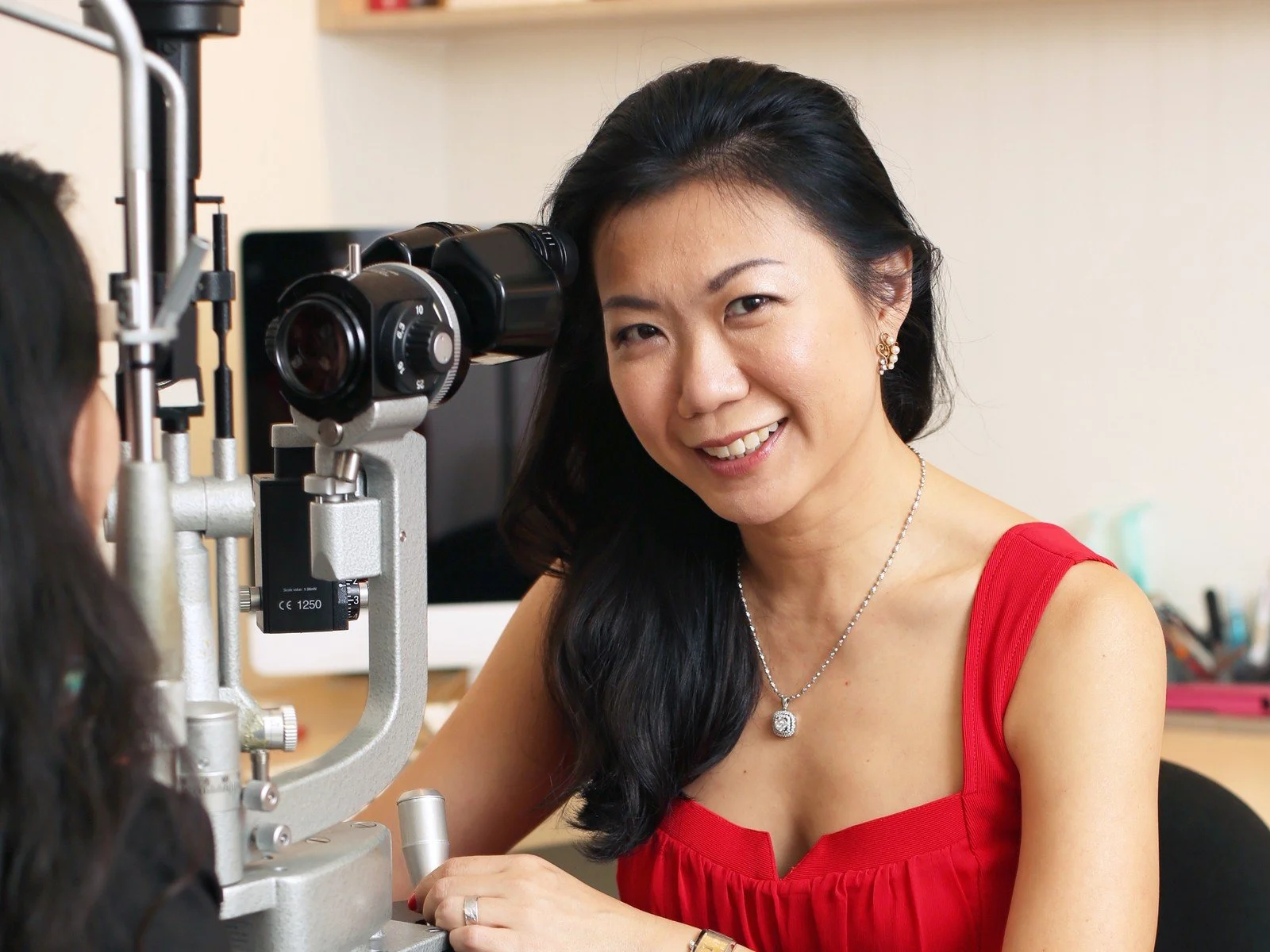
The Cataract Surgery Journey
From your first consultation to your final check-up
Time from first consult to surgery date can happen within days but if you want a letter of guarantee from the insurance it can take a few weeks.
Let me walk you through the whole journey.
I am Dr Cheryl Lee, an ophthalmologist. I am happy to consult in English, Mandarin, Teochew, Hokkien, French, Spanish, Russian and Malay, so you and your family can ask every question in the language you are most comfortable with.
Step 1: Your consultation and eye check
You will first see me at The EyeClinic. I will examine your retina and optic nerve and look carefully for dry eye.
A cataract may be responsible for your blurred vision, but it may not be the only reason. I want to understand the health of the whole eye before recommending surgery.
If I find dry eye, I may recommend treating it first, before we take further measurements.
Step 2: Measurements and choosing your lens
If everything looks good, you can go on to further tests that calculate the power of your intraocular lens (IOL).
We then choose your lens together. I don't begin by asking which lens is the most expensive. I begin by asking: how would you like to see?
Will I still need glasses?
It depends on your eyes and the lens you choose. Many patients find they depend on glasses much less. However, no lens suits everyone, and no lens can promise perfect vision at every distance in every situation. We will talk this through in detail when we meet.
Step 3: Booking your surgery
Once you have decided, we will book a date for your surgery. Surgery takes place at Mount Elizabeth Hospital or Aptus Surgical at Paragon, and we will tell you which one when you book.
If you are travelling from overseas, it is ideal if you can stay in Singapore for about three days. I will arrange your check-ups around your travel plans.
There is no fixed timeline for operating on the second eye. We will discuss this when we meet.
Financial counselling is done in the clinic.
Step 4: Preparing for surgery
For three days before surgery, please use the eyelid wipes we give you to keep your lashes clean.
You will need to fast for eight hours before surgery.
Please take your usual medications as normal. If you have diabetes, we will tell you whether to take your diabetes medication.
If you take blood thinners, and they can safely be stopped, we usually suggest stopping them about five days to a week before surgery, but this is not essential. Please do not stop any medication on your own. Follow our instructions.
Step 5: The day of surgery
Please arrive one to two hours before your surgery.
The procedure can be done under sedation or under local anaesthetic, and we will decide together which suits you. The aim is that you are comfortable throughout.
For one eye, the operation usually takes me about 11 minutes.
Step 6: After surgery
After your surgery, you will rest and be observed for two hours, and then you can go home. From arrival to going home, this is roughly three to four hours.
Do bring and wear your sunglasses after the procedure.
You can go home with a family member or friend, or take a taxi.
If you need to fly, you can travel on the same day. I will advise you on your own situation.
Step 7: Aftercare and check-ups
For about a month after surgery, you will use eye drops about four times a day. At each review, I will tell you what you need next.
I use two weeks as a rough guide for aftercare. During this time, please avoid:
Combat sports
Water sports
Eyelash extensions
Wearing eye makeup
Any activity involving soil
I will see you on day 3, day 7, and one month after your surgery. At the day 3 review, I check that you are using your drops properly, and I check your retina, your vision and your eye pressure.
If you are from overseas, I will arrange your check-ups around your timing.
Step 8: Looking after your eyes in the long term
Before your surgery, I want you to know this: some patients find, months or even years after cataract surgery, that their vision becomes blurred again.
This is usually not the cataract coming back. It is because the thin capsule behind your lens implant has become cloudy. This is called posterior capsule opacification, or PCO, and it does not happen to everyone.
If it does happen, it can usually be treated in the clinic with a YAG laser capsulotomy. It takes only a few minutes, needs no incision, and is usually needed just once. As with any treatment, there are risks, and I will explain them before we proceed.
Read more about PCO and YAG laser →
Questions you may have
What do I need to do to prepare for surgery?
For three days before surgery, please use the eyelid wipes we give you to keep your lashes clean. You will need to fast for eight hours before surgery. Please take your usual medications as normal. If you have diabetes, we will tell you whether to take your diabetes medication. If you take blood thinners, and they can safely be stopped, we usually suggest stopping them about five days to a week before surgery, but this is not essential. Please do not stop any medication on your own. Follow our instructions.
How early should I arrive, and where is the surgery done?
Please arrive one to two hours before your surgery. Surgery takes place at Mount Elizabeth Hospital or Aptus Surgical at Paragon, and we will tell you which one when you book.
How long does cataract surgery take?
For one eye, it usually takes me about 11 minutes. You should allow extra time for preparation before surgery and observation afterwards.
How long will I be there in total?
Please arrive one hour before if you are going to Aptus surgical centre to two hours before your surgery if going to Mount Elizabeth Hospital The operation usually takes me about 11 minutes for one eye, and you will then be observed for two hours before you go home. In total, this is roughly three to four hours.
Will I need an eye shield after surgery?
No. You will go home without an eye shield and with a pair of sunglasses. You can go home with a family member or friend, or take a Grab. My aim is that you do not look like you have even had surgery :)
Can I fly straight after surgery?
If you need to, you can fly on the same day. I will advise you on your own situation.
Will I still need glasses after surgery?
It depends on your eyes and the lens you choose. Many patients find they depend on glasses much less. However, no lens suits everyone, and no lens can promise perfect vision at every distance in every situation. We will talk this through in detail when we meet.
How long will I need eye drops?
For about a month after surgery, you will use eye drops about four times a day. At each review, I will tell you what you need next.
How many check-ups will I need?
I will see you on day 3, day 7, and one month after your surgery. At the day 3 review, I check that you are using your drops properly, and I check your retina, your vision and your eye pressure. I use two weeks as a rough guide for aftercare, during which you should avoid combat sports, water sports, eyelash extensions, eye makeup and any activity involving soil.
I live overseas. How long should I stay in Singapore?
If you are travelling from overseas, it is ideal if you can stay in Singapore for about three days. I will arrange your check-ups around your travel plans.
How long should I wait before surgery on the second eye?
There is no fixed timeline. We will discuss this when we meet.
My vision became blurred again after cataract surgery. Has my cataract come back?
Once a cataract has been removed, it cannot grow back. But some patients develop clouding of the capsule behind the lens implant months or years later. This is called posterior capsular opacity(PCO), and it can usually be treated with a quick YAG laser procedure with no incision. Read more here PCO.
—— Dr Cheryl Lee, Ophthalmologist