

THE EYECLINIC BY DR CHERYL LEE
No laser · No corneal tissue removed · reversible· corrects high myopia and astigmatism · no dry eyes · even for patients not suitable for Lasik
EVO ICL surgery
in Singapore
A more considered approach to vision correction.
EVO ICL Surgery in Singapore
For those who want to see clearly, without permanently reshaping the cornea.
Personal care, throughout your ICL journey.
I look after my patients personally, from the initial assessment and surgical planning to the procedure and subsequent follow-up.
I want you to understand your options, feel comfortable asking questions and know that your care is not handed over to a different team at every stage.
What is an EVO ICL?
An EVO Implantable Collamer® Lens, commonly known as an ICL, is a soft lens placed inside the eye to correct short-sightedness and, where appropriate, astigmatism.
The lens sits behind the iris—the coloured part of the eye—and in front of your natural lens.
You cannot see it.
You do not feel it.
And unlike laser vision correction, the cornea is not permanently reshaped.
The prescription is corrected with a lens rather than by removing corneal tissue.
For the right patient, it is an elegant and sophisticated approach to vision correction.
Wondering whether your eyes are suitable? The first step is a conversation and a careful assessment, with me.
Why I have chosen to specialise in ICL
“I have chosen not to reshape the cornea when, for a suitable patient, I can correct their vision while leaving it untouched.”-Dr Cheryl Lee
I have spent my career understanding the different ways we can correct vision.
And I have made a deliberate choice.
LASIK has helped many people and remains an established procedure. But it corrects vision by permanently reshaping the cornea.
For patients whose eyes are suitable for ICL, I have chosen a different approach.
An approach that corrects the prescription with a lens while leaving the cornea untouched.
An approach that can preserve important options for the future.
And an approach that, when carefully planned and performed, can provide extraordinary freedom from glasses and contact lenses.
That is why I have chosen to specialise in ICL.
ICL is not simply an alternative for people who cannot have LASIK
ICL is sometimes presented as an option for patients with thin corneas or very high prescriptions who are unsuitable for laser vision correction.
That is not how I see it.
Of course, not every eye is suitable for ICL.
The anatomy and health of the eye must be carefully assessed.
But when an eye is suitable, ICL should not simply be thought of as a second choice.
It represents a different philosophy of vision correction.
One that corrects the prescription without permanently reshaping the cornea.
One that can correct significant levels of myopia.
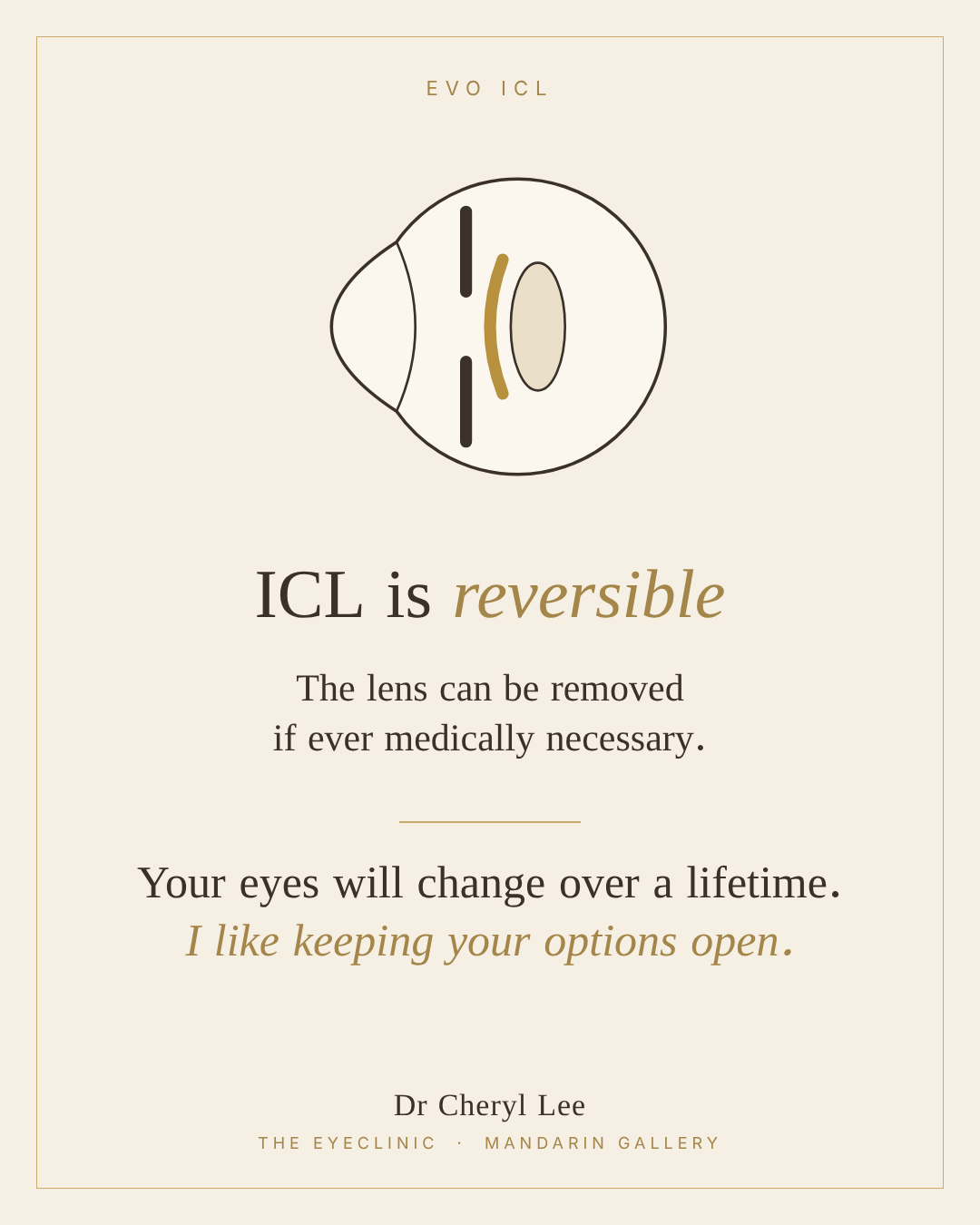
And one that can be removed in the future. If presbyopia or cataracts develop with age, the lens can come out and the eye is as it was.
For the appropriately selected patient, I believe ICL is not a compromise. It is a considered choice.
The difference is in the details
An ICL is not simply chosen according to your spectacle prescription.
Your prescription is only one part of the story.
The internal anatomy of your eye matters.
The relationship between the ICL, the iris, the natural crystalline lens and the structures behind the iris all need to be carefully understood.
This is why I place great importance on detailed pre-operative assessment and individualised planning.
Where appropriate, I use ultrasound biomicroscopy, or UBM, to give me a more detailed understanding of the anatomy of the eye and to assist in planning the procedure.
I believe good ICL surgery begins long before the day of surgery.
It begins with careful measurements.
Careful interpretation.
Appropriate lens selection.
And understanding that there is no such thing as a standard eye.
The surgery itself may take me about 5 minutes but the planning behind it should never be rushed.
Will my eyes change with age?
Your eyes will change over the years. Most of us develop presbyopia in our forties and fifties, and some of us develop cataracts later in life.
This is one of the reasons I am so comfortable with ICL.
Years ago, I met a German lady living in Singapore who had received one of the very first ICLs in the world, 25 years earlier. She had developed presbyopia and wanted a multifocal lens so she would not need reading glasses.
When I removed her ICLs, there were no signs of scarring at all. They slipped out like a dream.
For me, that is the best proof of reversibility. Cataract surgery afterwards is straightforward, with every lens option available to you.
"Although an ICL can be surgically removed if medically necessary, removal is another intraocular procedure. It does not mean that every consequence of surgery can necessarily be reversed or that the eye returns exactly to its original state."
Will I get Dry eyes after ICL ?
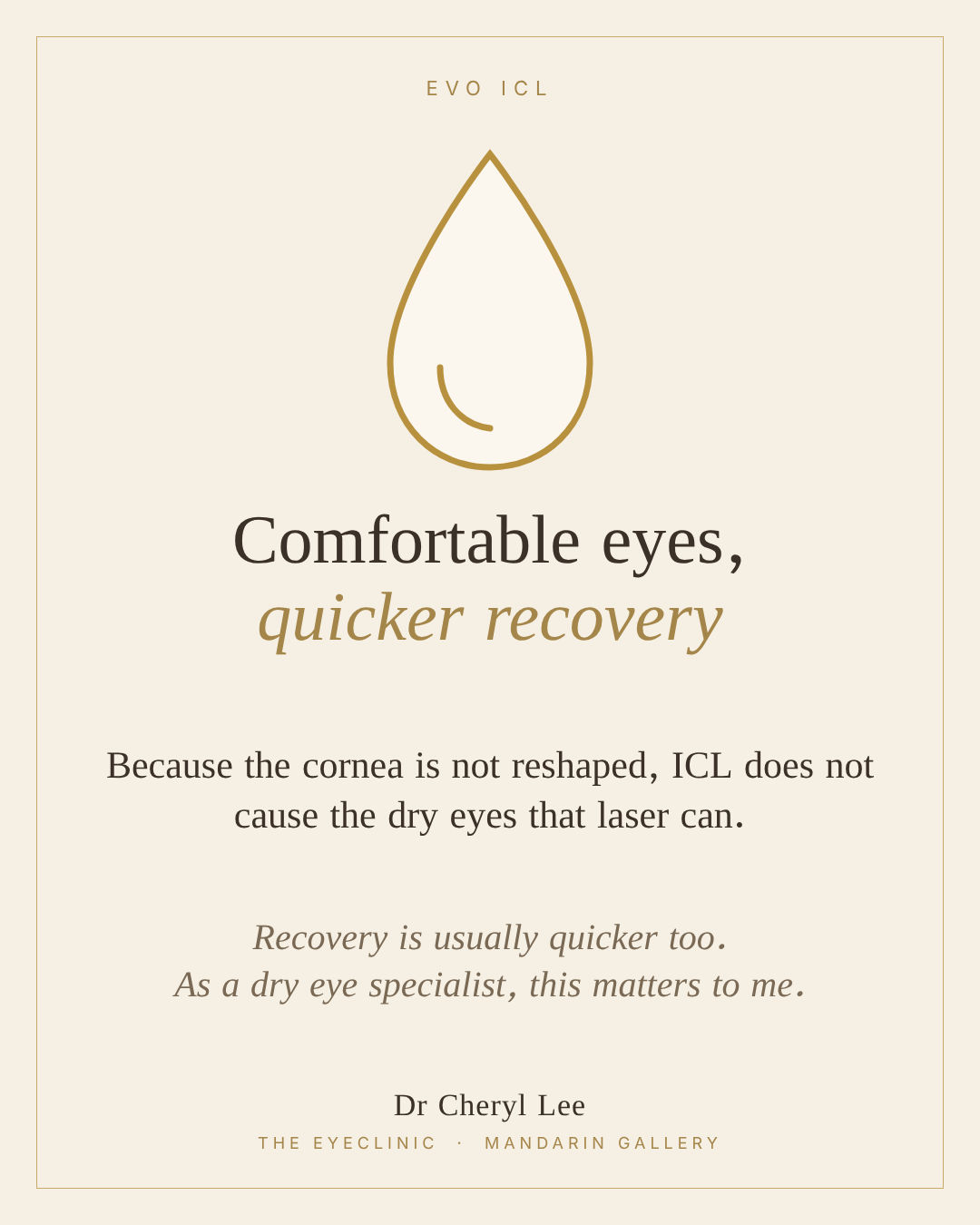
ICL does not involve cutting a corneal flap or reshaping the cornea, so it does not cause dry eyes the same way that can follow laser vision correction.
Could EVO ICL be right for you?
You should consider the ICL if you:
— Are short-sighted, especially those with high myopia
— Have astigmatism
— Have thin corneas
— Prefer not to permanently reshape and thin your cornea
— Lead an active lifestyle
— Do not want dry eyes
— Are looking for a long-term reversible approach to vision correction
Not sure if this describes you?
Suitability depends on the anatomy of your eye, not just your prescription. That is exactly what your ICL screening is for.
WhatsApp us on +65 9788 9080
Experience matters. But so does judgement.
ICL surgery is a sophisticated procedure.
But technology alone does not create an excellent outcome.
Patient selection matters.
Measurements matter.
Understanding the anatomy of the individual eye matters.
Lens selection matters.
Surgical experience matters.
And knowing when not to operate matters too.
I have had the privilege of caring for patients for more than 35 years and of working internationally at leading eye centres in Singapore, the United Kingdom, the United States and France.
My experience has shaped the way I practise today.
I am meticulous.
I take my time to understand the details.
And I do not believe that surgery should ever feel like a transaction.
When you come to The Eye Clinic, you are not entering a production line.
You are trusting me with your eyes, and I take that responsibility personally.
Your ICL process
Step 1: What tests are done before ICL surgery?
Suitability for ICL with a simple eye scan to assess the anterior chamber depth of your eye
Assess the health of the retina with a scan.
A ultrasound biomicroscopy to determine the ICL size
Step 2: Planning
Your lens is individually selected and sized for your eye. The ICL is ordered and is shipped form Switzerland, which takes about 5 days. Choose your date of ICLsurgery
Step 3: Your day of surgery
The Surgery is done at Aptus Paragon a 10 min walk away. The whole process takes half a day as you would check in one hour before, the surgery takes about 5 minutes in one eye and you would be fed a croissant before leaving the surgical theatre. Afterwards you will come back to clinic for a check of vision and eye pressure before heading home.
Step 4: Your recovery
Straight after, you will be walking around and many have started being on the phone with no patch over the eye. I see you for your check-ups the same day, day 3 , 7, 14 and 30 and you can reach me or my team if you have any concern.
You are never on a production line. You are my patient before, during and after.
Why did Rochelle choose ICL instead of Lasik? What happened at her first appointment? Join us in the operating room and see her finish by dressing up in Cosplay as Nappyraptor.
Patient’s testimonial of glasses to freedom with the swiss implantable contact lens and how it helps her with her Cosplay Nappyraptor-The Eyeclinic by Dr Cheryl Lee
-

Dr Cheryl Lee's ICl experience
I have been an ICL doctor for more than a decade, teaching as well as being an expert opinion leader globally.
-

Gold standard ICl measurements
Problems with ICL outcome can be prevented by correct ICL sizing. For me, we would not have a patient take risks that can be prevented.
-

My ICL write ups
Myopia is so common and I have wanted to create awareness of the options available so patients can make informed choices
ICL FAQs
Is ICL safe?
All surgery carries some risk, and I would be doing you a disservice if I did not say so. Prevention of problems is very important and that is the advantage of doing a pre-operative UBM . Read more here. This is why I take such care over patient selection, and why I will tell you if you are not suitable.
Who is ICL suitable for?
Short-sighted adults, including those with high myopia and astigmatism, whose eye anatomy has been assessed as suitable. Many people with thin corneas or a wish to avoid dry eyes also choose ICL.
Will I get dry eyes?
ICL does not involve cutting a corneal flap or reshaping the cornea, so it is not associated with the dry eye that can follow laser vision correction. You may already have dry eyes so I would treat that properly first before the ICL procedure at our specialist dry eye centre.
Can I wear cosmetic contact lenses, play sport or fly afterwards?
Absolutely yes. As shown by Nappyraptor’s video above.
What if I need cataract surgery or reading help later?
The ICL can be removed, and all cataract lens options remain open to you.
Is it painful?
The wound is 10 % the size of a Lasik flap. That is why recovery is faster and is not painful.
Does the lens need to be replaced?
No. There is no expiry date.
If you are considering a life without glasses or contact lenses, come and talk to me.